
That They May Serve God
Essay by Ms. Rachel Willoughby, Theology Teacher
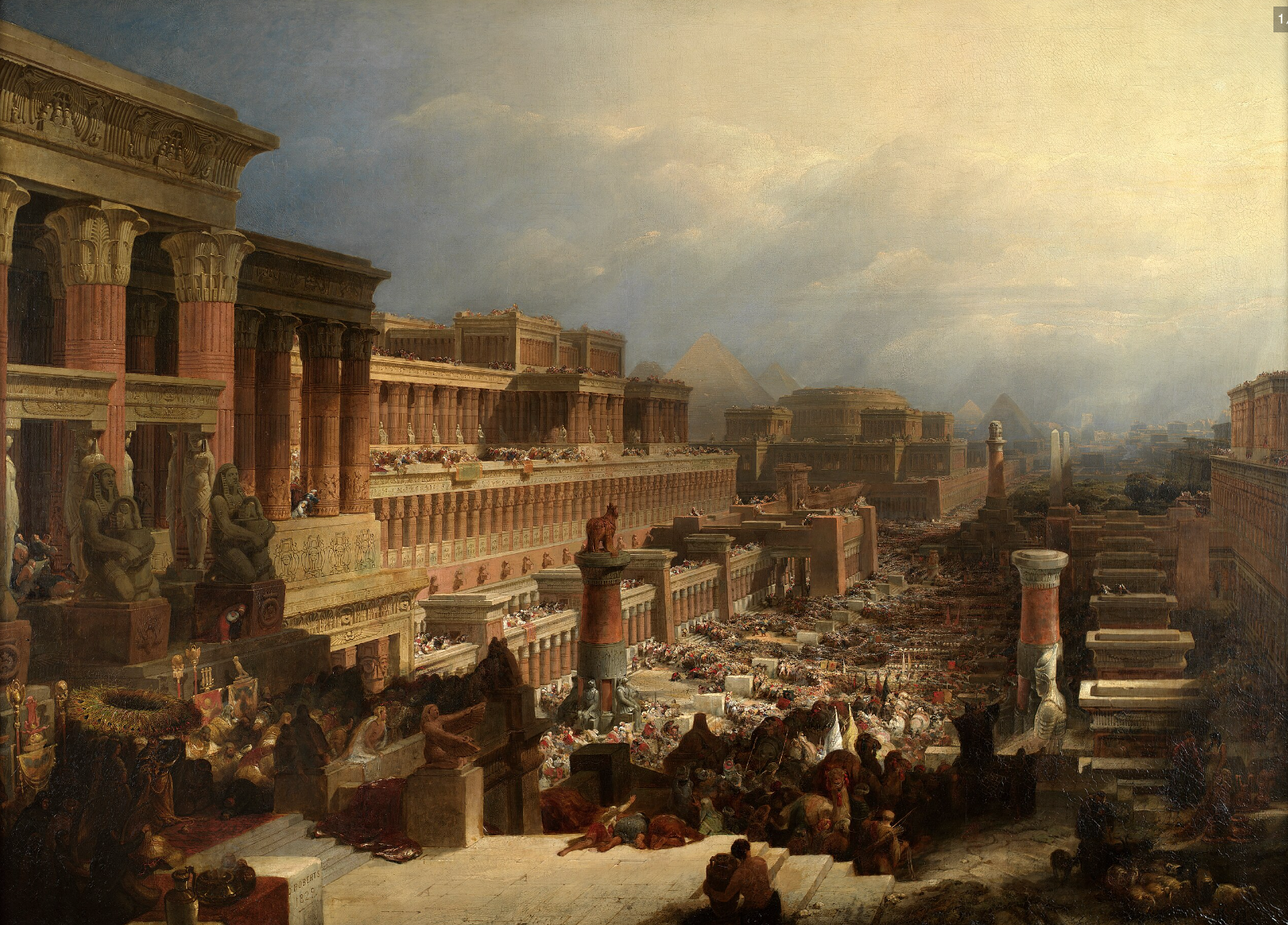
David Roberts, The Departure of the Israelites, 1829
“Blessed are the poor in spirit, for theirs is the kingdom of heaven.” (Matthew 5:3)
We heard this passage proclaimed, and likely commented upon, at Mass on Sunday. It calls to mind this new home to which we are invited. This first of the Beatitudes tells us of a preparatory condition for entering into the kingdom, namely poverty of spirit. Now, you might find yourself asking, as I often do, “What is poverty of spirit?” or “How might one achieve poverty of spirit?” or even, “What does it have to do with entering the kingdom of heaven?” As often happens, I find myself going back to the beginning in order to move forward. Let us travel together to the days leading up to the Exodus as we search for the switch that will shed light on our current conundrum.
To set the scene, after having spent a number of happy and successful years in Egypt, relations between the Egyptians and the Israelite people had deteriorated. The Israelites were manual laborers, enslaved and driven by Egyptian overlords. In God’s name and with His power, Moses and Aaron came to Pharaoh with a straightforward message: “Let my people go that they may serve me.” As we all know, Pharaoh did not comply with the obedience that typified the great patriarchs of the Old Testament – that would be a different story. Rather, he entered into a battle with God, pitching his own gods against the God of Abraham, Isaac and Jacob. This made things temporarily more challenging for the Israelites. Tasks were set that they could not complete, beatings ensued, and a general unhappiness with and distrust in this new plan for freedom plagued the Israelites. They took their complaints to Moses, who dutifully took them to God. Little did they know, this was the beginning of their training in poverty of spirit.
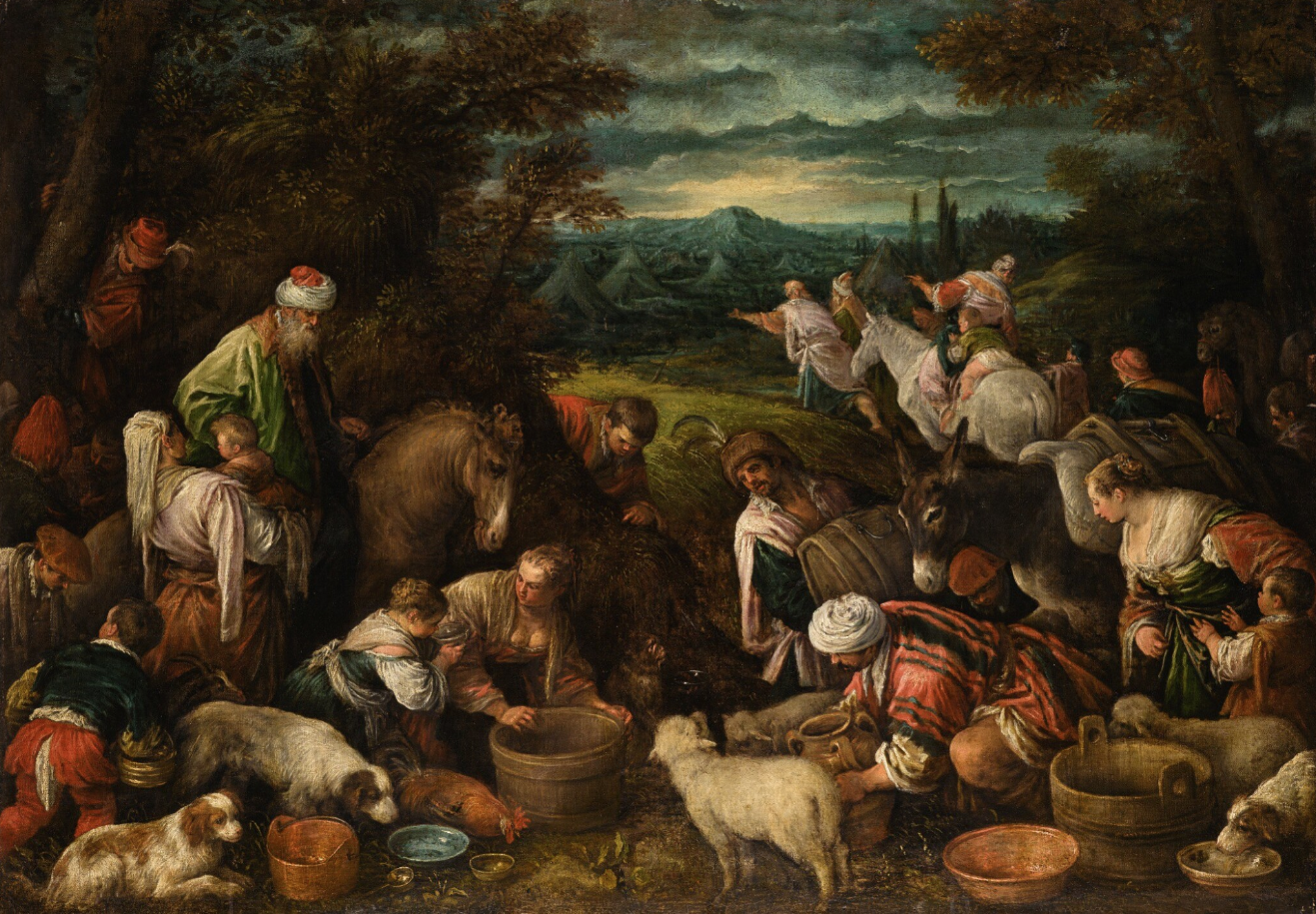
Jacapo Da Ponte, The Israelites in the Wilderness, 1570’s
So what is poverty of spirit? In the Summa Theologiae, St. Thomas reminds us that poverty is a detachment from material goods. Poverty of spirit, it follows, is a detachment from even immaterial, or spiritual, goods. When asked what he wants, the man who exemplifies poverty of spirit would say with St. Thomas, “non nisi Te, Domine” (“Nothing but You, Lord”). With Moses’ first request for freedom, the Israelites have entered a battleground, fighting for their own virtuous impoverishment of spirit. They had become accustomed to a certain standard of life in Egypt – Egyptian food, gods and customs had become a part of life. In The Spirit of the Liturgy, Cardinal Ratzinger calls the desert a training ground or a place of play, wherein the Israelites begin to practice for what they must become: a people completely oriented toward and dependent on God. Naturally, given their Egyptian attachments, there are some challenges and discomforts.
The Israelite distaste for discomfort resulting from Moses’ leadership was present from Moses’ first intervention on their behalf. Moses was forewarned that Pharaoh would have a hard heart, would not let the people go and that the plagues would follow, and yet Moses takes the peoples’ complaint to God, seemingly surprised. God responds:
“I am the Lord, and I will bring you out from under the burdens of the Egyptians, and I will deliver you from their bondage, and I will redeem you with an outstretched arm and with great acts of judgment, and I will take you for my people, and I will be your God; and you shall know that I am the Lord your God, who has brought you out from under the Egyptians. And I will bring you into the land which I swore to give to Abraham, to Isaac, and to Jacob; I will give it to you for a possession. I am the Lord.” (Exodus 6:6-8)
Here we see poverty of spirit introduced: to be free from bondage, to be redeemed, to be guided by God’s judgment, to be His people and to have Him as our God. To become free, however, will entail the discomfort of shedding Egyptian attachments. This requires that they recognize their bondage and begin to develop an image of what freedom could be. Pharaoh has made a demand that is impossible to fulfill and threatened punishment when the result is found lacking. Next, God systematically and symbolically puts to death the Egyptian gods by means of the plagues. When the Israelites flee, with an outstretched arm the Lord protects them from the Egyptians and then casts judgment on the Egyptians with the return of the waters and the drowning of the army. They are free from Pharaoh and the gods of Egypt, and they find themselves in the wilderness, dependent on their God.

Ercole de' Roberti, The Israelites gathering Manna, 1490’s
They find this radical, new life to be difficult, full of unexpected challenges. Though the setting is right for a newfound poverty of spirit, the people of Israel are not yet ready to embrace it. They will spend their time in the desert attempting to return to Egypt for the food, for the gods, for the water, or for safety. They attempt to bring Egypt with them. Consider the Golden Calf episode in Exodus 32, for example. They spend forty years learning detachment from the things of this world, eating the food God provided, drinking the water He gave them, turning to Him for protection and healing and walking away from Egypt and toward the Promised Land. When the time was right and the people were ready, they conquered Jericho in miraculous fashion and entered into the kingdom that God had promised so long ago.
This pattern is not confined to salvation history; it is mirrored in the interior life of the Christian. The Israelites have paved the way for us. As we pursue the kingdom of heaven, we can take comfort from their story. Poverty of spirit is not easily achieved or maintained during our desert wanderings; however it keeps the light shining on our end goal. In The Ladder of Divine Ascent, St. John Climacus writes of sitting on a high hill in one’s soul and observing the soul’s activity. Upon reflection, it seems there is a hive of activity that is reminiscent of the Israelites in their departure from Egypt and time in the desert. Some of the habits and activities of my interior life draw me to a more perfect worship of God, others pull me to sensual overindulgence. Left to itself, leaderless and chaotic, my interior life might be perfectly happy to remain in slavery to my personal Egypt of concupiscence and dis-integration. The advice of St. John Climacus leads me to believe that I am not alone in this tendency to remain attached to the fallen world and remain unprepared, or underprepared, for the kingdom of heaven.
What is the remedy? An exodus from my fallen heart to the Sacred Heart of Jesus. As his joys and sorrows become my own, what might have become disheveled or chaotic in my interior life begins to reorder. Attachments to this world fall away and poverty of spirit enters in. Joyfully, we do not work alone, but as one body, the Mystical Body of Christ. As we approach Lent, we prepare for our yearly Exodus out of our own bad habits and faulty attachments. We take steps toward the promised land, the Kingdom of Heaven. We allow the prayer, fasting and almsgiving of the season to reform our attachments. Will there be complaining from some of the unruly bits of my interior life as they are brought into order? Will the muscles of self-discipline suffer the soreness of previous disuse? There may be times when the soul cries out for Egypt because it remembers life to have been easier there. In those moments, the leadership of the Church and the encouragement of the Mystical Body of Christ fills in for Moses and reminds us that God provides. In our poverty, we remember the destination and allow our thoughts, words, and deeds to be guided and formed by that destination. As Lent approaches, we say to the false attachments, “Let us go that we may serve God in the wilderness.”